

Online Banking
That's no ordinary web page. It's a screen-sized Neighbors FCU branch.
With Online Banking, you can take care of almost any financial task, day or night - whenever it's convenient. And you can finish up fast.
A Better Banking Experience Is Here
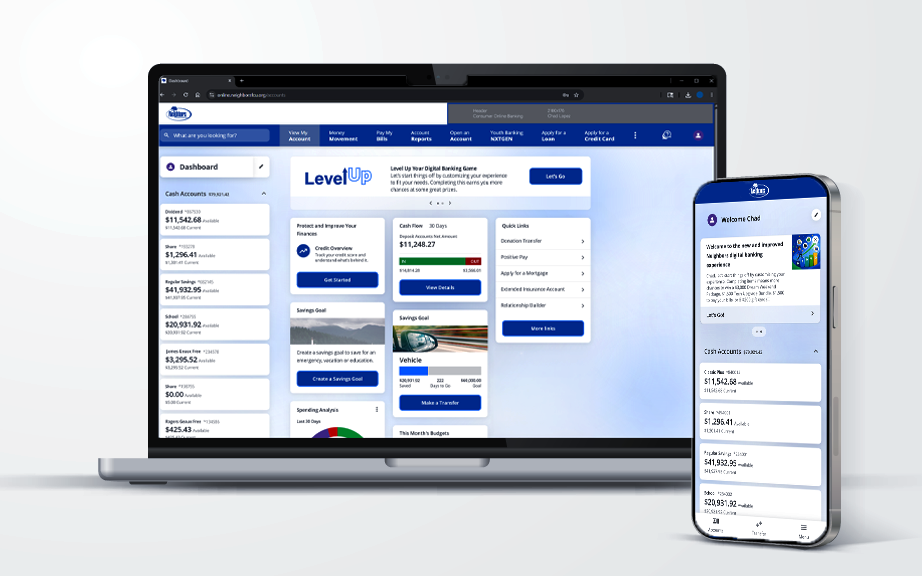
Your time is tight. Let's loosen things up a bit.
What's on today's to-do list? Maybe a dozen things. Maybe more. The good news is that with Neighbors digital banking, you can take care of important financial matters without making an extra trip. Just log on from your home, workplace or anywhere else, take care of business in a few minutes, and move on with your busy day.
- Get up-to-date account balances
- Transfer funds between accounts
- Make electronic bill and loan payments
- Review past transactions
- Access personal finance software
- Send money to friends and family with Zelle®
- Control your debit card
- Order checks
- View monthly e-Statements
- Receive alerts notifying you of important account activity
- Import accounts from other financial institutions
- View bill balances for monthly expenses
- Balances update automatically when you sign in
- Create your own dashboard view
- Categorize and track spending
- Set financial goals and track progress
New Digital Banking FAQs
- Log into your digital account via a web browser or the Neighbors mobile app
- Click Money Movement in the navigation bar
- In the menu choose External Accounts
- Verify your identity through the prompts provided
- Once you have verified your identity choose how you would like to add your external account
- Enter your account information for your external account and start transferring!
- Customize your dashboard so what matters shows first
- Manage your cards in one place
- Set savings goals and track progress
- Message us securely inside digital banking
- Enjoy a modern, streamlined experience across devices
- Connect to Wi-Fi. While it’s possible to automatically update apps over cellular data, we recommend using Wi-Fi instead. Apple iOS usually downloads updates only over Wi-Fi. Make sure your iPhone spends long periods of time connected to the Internet on a stable Wi-Fi network. This provides plenty of opportunities for it to download and update apps or software.
- Connect to power. Your iPhone will not download and install software updates if the battery is low. Keep your iPhone charged to at least 50 percent to encourage automatic software and app updates.
- Check your iPhone compatibility. If you’re waiting for a particular app or iOS update to install, it’s worth checking that your iPhone is compatible with that software. After all, you will wait a long time for an automatic software update that isn’t available for your device.
- Check your storage. Your iPhone may have stopped updating apps and software automatically because there isn’t enough free storage. This happens when you use too much space for existing apps, videos, music, and other media.
- Check for Apple server problems. Automatic iPhone software updates may not work due to an issue with Apple’s servers. If Apple’s servers are down, your iPhone can’t download updated software from them.
- Log into your digital banking via a web browser or the Neighbors mobile app
- Click on the account you would like to rename
- In the Account Details box on the right, click View Account Details
- Select the tag next to the account name
- Enter a new nickname
- Click Update
- Log into your digital banking account via a web browser or the Neighbors mobile app
- Click on your profile picture/icon
- Select Profile from the drop down menu
- Under Profile Details, update your contact information
- Log into your digital banking account via web browser or the Neighbors app
- Click on your profile picture/icon
- Select Security from the drop down menu
- Click the Change Password link to quickly and safely change your password
- Log into digital banking via a web browser or the Neighbors mobile app.
- Click on your Profile Picture/icon
- Select Security from the drop down menu
- On the Security Validation page, select Change Username
- Note: You may be prompted to verify your identity using a confirmation code that you choose to receive via text phone call. If you have push notifications set up you will verify using this method. Once you have entered and submitted the confirmation code, you will be directed to the Change User ID page
- Enter and confirm your New User ID
- User ID Requirements
- Have between 8-32 characters
- Only contain alphanumeric characters
- Contain at least one number
- Contain no whitespace
- User ID Requirements
- Select Update
- Log into your digital banking via a web browser or the Neighbors mobile app
- Select the three dots on the navigation banner and select Alerts from the drop down menu
- Choose the alert type you would like to set up and follow the prompts
- Select Save
- Note: There are no limits to the number of alerts a user may set up
- Internet Explorer
- Google Chrome
- Microsoft Edge
- Mozilla Firefox
- Safari
- Click the Forgot Password located on the login page
- Enter your User ID, date of birth in MM/DD/YYYY format and the last 4 digits of your Social Security Number
- You will be prompted to select how you would like to receive your identity verification confirmation code, by text or phone call
- If you do not have access to any of the listed phone numbers, please contact Member services at 225-819-2178
- Once you enter and submit your confirmation code, you will be prompted to create a new password
- Your new password must contain the following
- Have between 8-32 characters
- Contain at least one letter
- Contain at least one number
- Contain at least one of the following special characters @!#$%&
- Not contain whitespace
- Your new password must contain the following
- Subscription Alerts (transaction, balance, etc.)
- Balance Summary
- Check Cleared
- Transaction
- Courtesy Pay
- Security Alerts
- Log In
- Internal and External Transfers
- Text
- Push Notifications
- Log into your digital banking account via a web browser or the Neighbors mobile app
- Click the three dots in the navigation bar
- Choose Documents and Statements from the drop down menu
- Open your mobile app
- Underneath Username & Password, toggle "Enable Authentication"
- Confirm your credentials when prompted.
- Login
- Open your mobile app
- Underneath Username & Password, toggle "Enable Authentication"
- Confirm your credentials when prompted.
- Login
- Open your mobile app
- Underneath Username & Password, toggle "Enable Authentication"
- Confirm your credentials when prompted.
- Login
- Log into the mobile app
- Click the Menu icon in lower right corner
- Click "Quick Balance" within list
- Follow Quick Balance widget instructions
- Log into the mobile app
- Click the Menu icon in lower right corner
- Click "My Cards" within list
- Under Card details>Click Rewards to redirected to uChoose Rewards site
- Click the Menu icon in lower right corner
- Click "Log Out" in the list
Quicken Conversion Instructions
IMPORTANT: Express Web Connect will not be available until 5 business days after the 2nd Action Date, so please utilize another connectivity type if you need transaction updates during this downtime.
- Backup your Quicken Mac data file and update the application.
- Choose File > Save a Backup.
- Download the latest Quicken Update. Choose Quicken > Check for Updates.
- Complete a final transaction download.
- Complete last transaction update before the change to get all of your transaction history up to date.
- Repeat this step for each account you need to update.
- Accept all new transactions into the appropriate registers.
Activate online banking connection for accounts connected to financial institution that is requesting this change.
- Select your account under the Accounts list on the left side.
- Choose Accounts > Settings.
- Select Set up transaction download.
- Enter your financial institution name in the search field, select the correct option and click Continue.
- Log into your financial institutions online banking site and download your transactions to your computer.
Important: Take note of the date you last had a successful connection. If you have overlapping dates in the web-connect process, you may end up with duplicate transactions. - Drag and drop the downloaded file into the box titled Drop download file. Choose Web Connect for the “Connection Type” if prompted
- In the “Accounts Found” screen, ensure you associate each new account to the appropriate account already listed in Quicken. Under the Action column, click Link to pick your existing account.
Important: Do NOT select “ADD” in the Action column unless you intend to add a new account to Quicken. - Click Finish.
- Backup Quicken Windows Data File and Update.
- Choose File > Backup and Restore > Backup Quicken File.
- Download the latest Quicken Update. Choose Help > Check for Updates.
- Complete a final transaction download.
- Complete last transaction update before the change to get all of your transaction history up to date.
- Repeat this step for each account you need to update.
- Accept all new transactions into the appropriate registers.
- Deactivate online banking connection for accounts connected to financial institution that is requesting this change.
- Choose Tools > Account List.
- Click Edit on the account to deactivate.
- In Account Details, click Online Services.
- Click Deactivate. Follow prompts to confirm deactivation.
- Click the General tab.
- Delete Financial Institution and Account Number information.
- Click OK to close window.
- Repeat steps for any additional accounts.
- Reconnect online banking connection for accounts that apply.
- Download a Quicken Web Connect file from your financial institution’s online banking site.
- In Quicken, choose File > File Import > Web Connect (.QFX) File.
- Use the import dialog to select the Web Connect file you downloaded. An “Import Downloaded Transactions” window opens.
- Choose Link to an existing account. Select the matching account in the drop-down menu. Associate the imported transactions to the correct account listed in Quicken.
- Repeat this step for each account you have connected to this institution.
Online Banking Security Information
Keeping Your Online Banking Secure
At Neighbors Federal Credit Union, your security is our top priority. We’re committed to helping you protect your personal and financial information every time you access Online Banking. This section provides practical tips and best practices to ensure you’re logging in safely, recognizing legitimate Neighbors FCU sites and communications, and keeping your accounts protected from online threats.
- Check the URL carefully
- Ensure the website starts with “https://”- the “s” indicates it uses a secure connection.
- The domain name should exactly match your bank’s official site (e.g., https://www.neighborsfcu.org and https://neighborsfcu.onlinebank.com), not a variation or misspelling like neighborsfcu-login.com.
- Verify the Security Certificate
- Click the padlock icon in the browser's address bar.
- Avoid sites with certificate warnings as they may be fraudulent or insecure.
- Use official links only
- Access online banking by:
- Typing the address directly into your browser
- Using a saved bookmark that you know is legitimate
- Clicking a link on the official Neighbors FCU site
- Follow a link from a verified Neighbors FCU email
- Access online banking by:
- Look for signs of authenticity
- The page design, logo, and language should look professional and consistent with Neighbors FCU branding
- Watch for spelling errors, odd phrasing, or urgent login prompts - these are red flags
- Keep your system and browser updated
- Regular updates help protect against phishing and fake site attacks
- Use antivirus or browser security tools that flag unsafe sites
In today’s digital world, a strong password is the first line of defense against cyber threats. Weak or reused passwords can make your accounts vulnerable to hacking, identity theft, and data breaches. Follow these key principles to create secure passwords that protect your information:
- Use length and complexity - Aim for at least 12 to 32 characters. Combine uppercase and lowercase letters, numbers, and symbols. The longer and more varied your password, the harder it is to crack.
- Avoid common phrases - Don't use personal information such as birthdays, names, or simple sequences like "12345" or "password". Attackers often try these first.
- Create passphrases - Instead of a single word, use a random phrase that's easy to remember but difficult to guess, such as BlueRain!CoffeeBridge92.
- Use unique passwords for every account - Reusing passwords across sites means one breach can compromise all your accounts.
- Enable two-factor authentication (2FA) - Whenever possible, add an extra layer of security that requires a code or device confirmation in addition to your password.
- Use a password manager - These tools can generate, store, and autofill complex passwords securely, so you don't have to remember them all.
By following these practices, you'll significantly reduce your risk of unauthorized access and keep your online information safe.
Email is a convenient communication tool, but also a prime target for scams and data theft. Requests for confidential information should always be treated with caution. Here’s how to protect yourself and your information:
- Verify the sender - Check the sender's email address carefully. Look for misspellings or unusual domains that might mimic legitimate sources. If in doubt, contact Neighbors directly at 225-819-2178 or neighborsfcu.org. Do not use the phone number or links provided in the email if you suspect the email is fake.
- Be skeptical of urgency - Phishing emails often pressure you to act quickly. Take time to verify before responding - legitimate organizations rarely demand immediate action.
- Never share sensitive data by email - Do not send passwords, financial information, or personal identifiers through email, even if the request seems authentic.
- Check for red flags - Poor grammar, unexpected attachments, or generic greetings can signal a scam.
- Report suspicious emails - Notify Neighbors immediately so we can investigate and prevent further threats
By staying alert and following these steps, you can help protect sensitive data and reduce the risk of email-based cyberattacks.
Unauthorized Access Warning
All activities on this system are monitored for security and compliance purposes.
Neighbors Federal Credit Union is a full-service financial institution with branches serving the South Louisiana parishes of Ascension, East Baton Rouge, East Feliciana, Iberville, Livingston, Pointe Coupee, St. Helena, West Baton Rouge and West Feliciana.

Expert Counseling for a Brighter Financial Future
- Free, confidential advice
- Take control of your financial future
- Review your current situation
- Get a plan to move forward